
Course Description
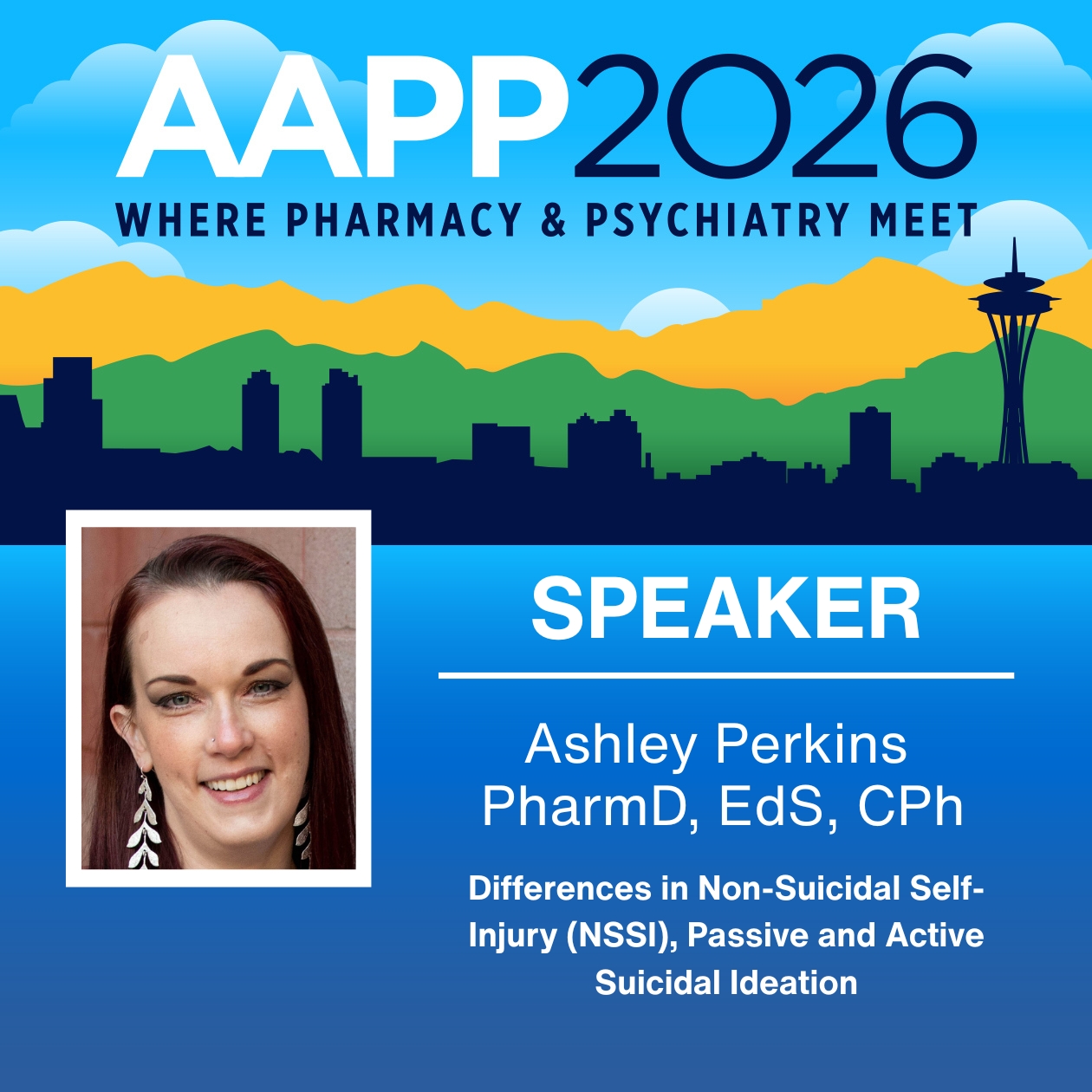
Accurately distinguishing between non-suicidal self-injury, passive suicidal ideation, and active suicidal ideation is essential for effective suicide risk assessment and intervention. This session will clarify key definitions, explore the clinical differences between these behaviors and thought patterns, and highlight evidence-based screening tools used to identify and respond to each. Psychiatric pharmacists will gain practical knowledge to enhance suicide prevention efforts and ensure patients receive appropriate, targeted care.
This is a member-submitted program!
Each year, topics are collected from psychiatric pharmacy subject matter experts (SMEs) to meet the educational needs of our learners. The planning committee selects all SME speakers and oversees the development of the content according to accreditation processes and standards.
Learning Objectives
- Define non-suicidal self-injury (NSSI), passive suicidal ideation (SI), and active suicidal ideation.
- Explain the differences between NSSI, passive SI, and active SI.
- Identify appropriate screening tools for NSSI, passive SI, and active SI.
Target Audience
If you are a pharmacist, nurse practitioner, or other health care professional involved in the comprehensive medication management of individuals living with mental health and/or substance use disorders, we invite you to participate in this course.
Faculty

View biographical information
Ashley Perkins, PharmD, EdS, CPh
Co-Founder and Board President
We Matter Too, Inc.
Orange Park, FL
Ashley Perkins, PharmD, EdS, CPh, is a mental health advocate, educator, and pharmacist with a passion for empowering others to improve and take ownership of their mental health. Ashley earned her Doctor of Pharmacy from Butler University's College of Pharmacy and Health Sciences in 2008 and is currently pursuing an Ed.D. at Marshall University, focusing on curriculum and instruction. The title of her dissertation, currently in progress is, Impact of Language and Stigma in Medical Education: Improving Curriculum to Foster Reflection and Empathy.
Dr. Perkins’ passion for mental health advocacy was ignited by personal experience of discrimination in 2019. Now, she draws from her own journey of managing ADHD, autism, anxiety, agoraphobia, and PTSD to inspire and support others facing similar challenges. This led her to co-found We Matter Too, Inc., a non-profit organization that shares first-person narratives of lived experiences to help those struggling with mental health issues and mental illnesses. In addition to her work with We Matter Too, Perkins has written a book, ""I Matter Too,"" which shares her personal story and provides information about how to navigate life through those experiences. Drawing from personal experiences of discrimination and stigma, Dr. Perkins is on a mission to increase awareness and education in the medical community surrounding mental health. Her focus is not only on improving recognition of mental health issues, but also reducing the stigma that often accompanies them. With her own journey as her driving force, she seeks to inspire and empower others facing similar struggles.
Perkins has received numerous accolades for her work, including the 2021 WEGO Health Awards Rookie of the Year. She is also a sought-after speaker and has shared her expertise on mental health at conferences around the world, including a TEDx talk titled “Mental Disease: Empower Others by Sharing Your Story” where she discusses the importance of destigmatizing mental health issues through the power of personal storytelling and reducing stigma and fear of judgment.
Course Requirements
To receive ACPE credit for this session, you must:
- Register for this course.
- Review the full content of the activity and reflect upon its teachings.
- Complete the evaluation at the end of the activity.
- Provide the necessary details in your profile to ensure correct reporting by AAPP to CPE Monitor.
Continuing Education Credit and Disclosures
Activity Dates: 4/21/2026-4/21/2029
ACPE Contact Hours: 1.0
ACPE Number: 0284-0000-26-032-H01-P (Knowledge)
Nursing Credit Reminder: Note that ACPE credit is accepted for ANCC Certification Renewal and AANPCB advanced practice provider content. For specific questions related to your organization's acceptance of ACPE continuing education units, please contact your organization directly.
 The American Association of Psychiatric Pharmacists is accredited by the Accreditation Council for Pharmacy Education as a provider of continuing pharmacy education.
View Faculty and Program Planning Committee Disclosures of Interest
Faculty: Ashley Perkins, PharmD, EdS, CPh has nothing to disclose
Planning Committee: Members and disclosures listed here
View AAPP's Disclaimer and Disclosure Declarations
AAPP Disclaimer: Participants have an implied responsibility to use the newly acquired information to enhance patient outcomes and their own professional development. Any procedures, medications, or other courses of diagnosis or treatment discussed or suggested in this activity should not be used by clinicians without evaluation of their patient’s conditions and possible contraindications on dangers in use, review of any applicable manufacturer’s product information, and comparison with recommendations of other authorities. Please refer to the official prescribing information for each product for discussion of approved indications, contraindications, and warnings.
Unlabeled Use Disclosure: Faculty of this CE activity may include discussions of products or devices that are not currently labeled for use by the FDA. The faculty have been informed of their responsibility to disclose to the audience if they will be discussing off-label or investigational uses (any uses not approved by the FDA) of products or devices. The faculty, planners, and American Association of Psychiatric Pharmacists do not endorse the use of any product outside of the FDA labeled indications. Medical professionals should not utilize the procedures, products, or diagnosis techniques discussed during this activity without evaluation of their patient for contraindications or dangers of use.
View AAPP's Copyright Statement, Terms of Use, and Policies
AAPP owns the copyright, is licensed or has received permissions for use of, or is otherwise permitted to use copyrighted materials within any CPE activity. Authors and speakers are required to obtain necessary copyright permissions for content in CPE activities. AAPP complies with copyright laws and regulations.
View AAPP's Privacy Policy. AAPP's Terms of Use and other policies on education programs, resources, toolkits, and other web based content/offerings are available here.
View AAPP's Fair Balance and Integrity Statement
It is the policy of AAPP to ensure independence, balance, objectivity, scientific rigor, and integrity in continuing education activities. Those involved in the development of this continuing education activity have made all reasonable efforts to ensure that information contained herein is accurate in accordance with the latest available scientific knowledge at the time of accreditation of this continuing education activity. Information regarding drugs (e.g., their administration, dosages, contraindications, adverse reactions, interactions, special warnings, and precautions) and drug delivery systems is subject to change, however, and the reader is advised to check the manufacturer’s package insert for information concerning recommended dosage and potential problems or cautions prior to dispensing or administering the drug or using the drug delivery systems.
Fair balance is achieved through ongoing and thorough review of all materials produced by faculty, and all educational and advertising materials produced by supporting organizations, prior to educational offerings. Approval of credit for this continuing education activity does not imply endorsement by AAPP for any product or manufacturer identified.