
Course Description
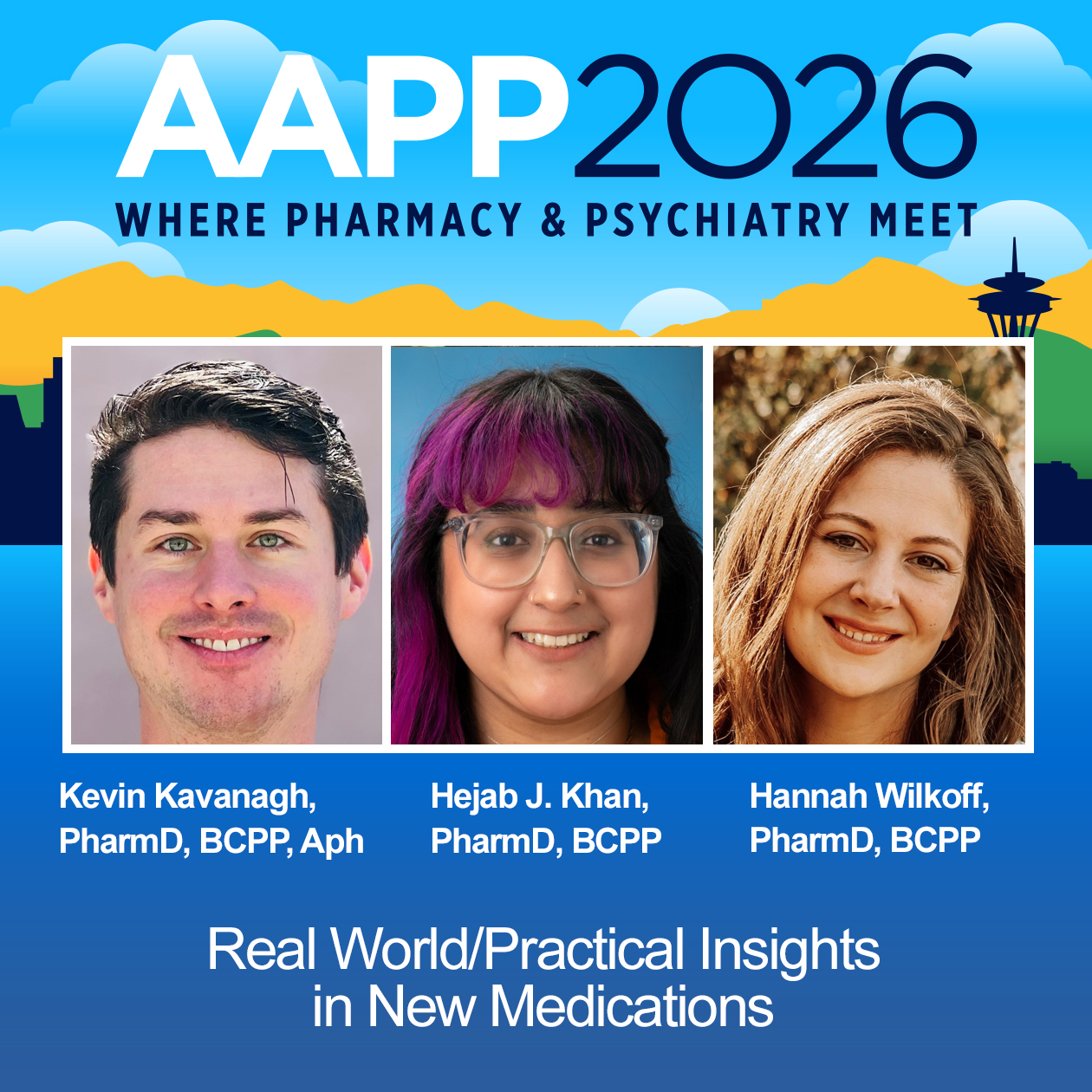
Discover the evolving landscape of psychotropic medications and how new advancements are reshaping mental health treatment. This presentation will delve into dexmedetomidine (Dr. Kavanagh), lumateperone (Dr. Khan), and xanomeline and trospium chloride (Dr. Wilkoff), highlighting their unique benefits and limitations. Gain practical insights into integrating these innovative therapies into clinical practice, potentially enhancing patient outcomes and expanding your treatment toolkit as a psychiatric pharmacist.
Learning Objectives
- Identify the clinical advantages and/or disadvantages of newer psychotropic medications.
- Discuss practical application and where newer psychotropic medications fit into clinical practice.
Target Audience
If you are a pharmacist, nurse practitioner, or other health care professional involved in the comprehensive medication management of individuals living with mental health and/or substance use disorders, we invite you to participate in this course.
Faculty



View biographical information
Kevin Kavanagh, PharmD, BCPP, Aph
Dr. Kevin Kavanagh is a board-certified psychiatric pharmacist who earned their doctorate of pharmacy degree from the University of Colorado Skaggs School of Pharmacy & Pharmaceutical Sciences. He completed his acute care pharmacy residency at Sharp Chula Vista Medical Center in Chula Vista, California, and his psychiatric pharmacy residency at Scripps Memorial Hospital in San Diego, California. Kevin works as a clinical psychiatric pharmacist at San Diego County Psychiatric Hospital, a publicly funded, free-standing, safety net psychiatric hospital for San Diego County with a large forensic and treatment-resistant patient population.
Together with his esteemed former colleague Dr. Jessica Jones, Kevin has spent the past 5 years creating and overseeing clinical pharmacy services at his worksite, including transitions of care, medication assisted treatment, long-acting injectable stewardship, and clinical consults. He is the lead medication safety pharmacist, pharmacist informaticist, and pharmacy educator at his hospital, and primary preceptor for APPE students and PGY2 psychiatric pharmacist residents. He also does clinical pharmacist stuff sometimes too. He is passionate about implementing data-driven systemic changes to support best practices and optimize patient outcomes.
Hejab J. Khan, PharmD, BCPP
Dr. Khan grew up in the Dallas, TX area before moving to Austin, TX to complete their PharmD at the University of Texas at Austin College of Pharmacy. During their time there, they were involved in their local chapter of AAPP as a social chair and served as a student chair for Operation Naloxone, helping distribute naloxone and educate the public on opioid overdose reversal.
They completed a PGY1 in Pensacola, FL and returned to their home state for a PGY2 in psychiatry at the South Texas Veterans’ Health Care System in San Antonio, TX. Their interest during residency was severe mental illness, and upon graduation, they were able to begin work as an ambulatory care clinical pharmacist specializing with those who live with severe and persistent mental illness. They currently live and practice in the San Francisco Bay area.
Hannah Wilkoff, PharmD, BCPP
Dr. Hannah L. Wilkoff, PharmD, BCPP, is a clinical pharmacist specializing in psychiatric care, with extensive experience across inpatient, outpatient, and educational settings. She currently serves as an Advanced Practice Pharmacist at the University of Maryland School of Pharmacy and Spring Grove Hospital, a 425-bed state psychiatric hospital where she covers multiple units, provides clinical education, and precepts pharmacy trainees. In addition, Dr. Wilkoff serves part time as a Clinical Pharmacy Specialist at Shady Grove Adventist Behavioral Health Hospital, supporting diverse patient populations including pediatrics, co-occurring disorders, and severe mental illness. She previously helped develop and lead an outpatient pharmacogenomics program at Frederick Health Hospital and completed PGY-1 and PGY-2 pharmacy residencies focused on psychiatric care.
Dr. Wilkoff is an active contributor to psychiatric pharmacy research and education, with multiple peer-reviewed publications, national presentations, and ongoing projects evaluating the impact of pharmacist-led interventions on mental health outcomes. She has presented her work in long-acting injectable antipsychotics, pharmacogenomics, and clinical service expansion in behavioral health at major conferences. A Board Certified Psychiatric Pharmacist, Dr. Wilkoff also participates in professional organizations such as the American Association of Psychiatric Pharmacists and the Board of Pharmacy Specialists, contributing to systematic literature reviews, certification standards, and continuing education initiatives.
Course Requirements
To receive ACPE credit for this session, you must:
- Register for this course.
- Review the full content of the activity and reflect upon its teachings.
- Complete the evaluation at the end of the activity.
- Provide the necessary details in your profile to ensure correct reporting by AAPP to CPE Monitor.
Continuing Education Credit and Disclosures
Activity Dates: 4/19/2026-4/19/2029
ACPE Contact Hours: 1.0
ACPE Number: 0284-0000-26-015-H01-P (Knowledge)
Nursing Credit Reminder: Note that ACPE credit is accepted for ANCC Certification Renewal and AANPCB advanced practice provider content. For specific questions related to your organization's acceptance of ACPE continuing education units, please contact your organization directly.
 The American Association of Psychiatric Pharmacists is accredited by the Accreditation Council for Pharmacy Education as a provider of continuing pharmacy education.
View Faculty and Program Planning Committee Disclosures of Interest
Faculty:
- Kevin Kavanagh, PharmD, BCPP, Aph has nothing to disclose
- Hejab J. Khan, PharmD, BCPP has nothing to disclose
- Hannah Wilkoff, PharmD, BCPP has nothing to disclose
Planning Committee: Members and disclosures listed here
View AAPP's Disclaimer and Disclosure Declarations
AAPP Disclaimer: Participants have an implied responsibility to use the newly acquired information to enhance patient outcomes and their own professional development. Any procedures, medications, or other courses of diagnosis or treatment discussed or suggested in this activity should not be used by clinicians without evaluation of their patient’s conditions and possible contraindications on dangers in use, review of any applicable manufacturer’s product information, and comparison with recommendations of other authorities. Please refer to the official prescribing information for each product for discussion of approved indications, contraindications, and warnings.
Unlabeled Use Disclosure: Faculty of this CE activity may include discussions of products or devices that are not currently labeled for use by the FDA. The faculty have been informed of their responsibility to disclose to the audience if they will be discussing off-label or investigational uses (any uses not approved by the FDA) of products or devices. The faculty, planners, and American Association of Psychiatric Pharmacists do not endorse the use of any product outside of the FDA labeled indications. Medical professionals should not utilize the procedures, products, or diagnosis techniques discussed during this activity without evaluation of their patient for contraindications or dangers of use.
View AAPP's Copyright Statement, Terms of Use, and Policies
AAPP owns the copyright, is licensed or has received permissions for use of, or is otherwise permitted to use copyrighted materials within any CPE activity. Authors and speakers are required to obtain necessary copyright permissions for content in CPE activities. AAPP complies with copyright laws and regulations.
View AAPP's Privacy Policy. AAPP's Terms of Use and other policies on education programs, resources, toolkits, and other web based content/offerings are available here.
View AAPP's Fair Balance and Integrity Statement
It is the policy of AAPP to ensure independence, balance, objectivity, scientific rigor, and integrity in continuing education activities. Those involved in the development of this continuing education activity have made all reasonable efforts to ensure that information contained herein is accurate in accordance with the latest available scientific knowledge at the time of accreditation of this continuing education activity. Information regarding drugs (e.g., their administration, dosages, contraindications, adverse reactions, interactions, special warnings, and precautions) and drug delivery systems is subject to change, however, and the reader is advised to check the manufacturer’s package insert for information concerning recommended dosage and potential problems or cautions prior to dispensing or administering the drug or using the drug delivery systems.
Fair balance is achieved through ongoing and thorough review of all materials produced by faculty, and all educational and advertising materials produced by supporting organizations, prior to educational offerings. Approval of credit for this continuing education activity does not imply endorsement by AAPP for any product or manufacturer identified.