
Course Description
Opening remarks will given immediately before this session starting at 7:58 AM Pacific Time.
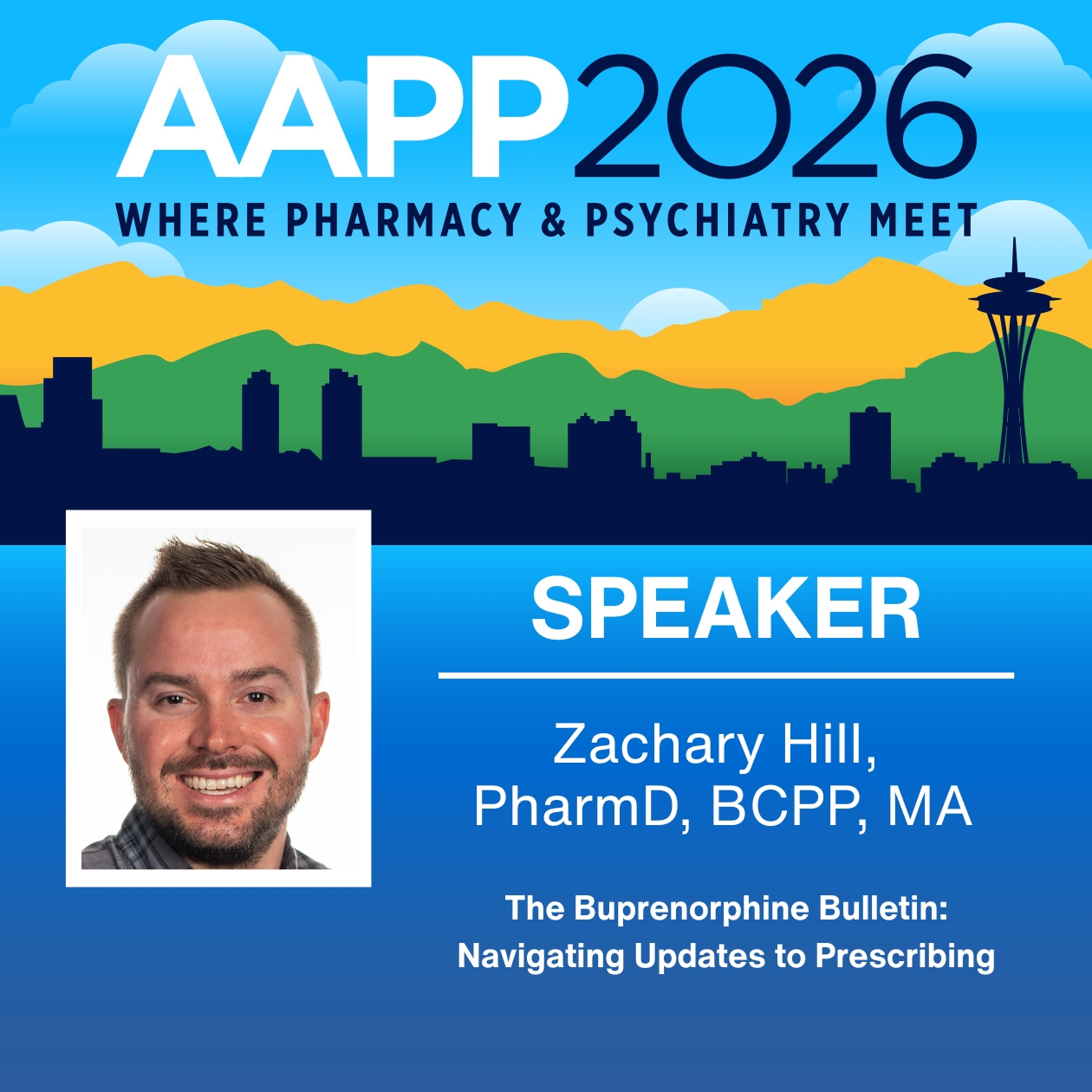 Buprenorphine prescribing continues to evolve, with recent updates to initiation guidance for extended-release subcutaneous formulations and growing interest in micro- and macro-dosing strategies. This session will review key changes in product labeling, outline core dosing principles across formulations, and examine emerging evidence to inform safe and effective treatment of opioid use disorder. Psychiatric pharmacists will gain timely insights to enhance their decision-making with buprenorphine.
Learning Objectives
- Discuss recent changes to the prescribing information for initiation dosing of extended-release subcutaneous buprenorphine.
- Outline dosing principles associated with various buprenorphine formulations.
- Explain key findings from available literature on buprenorphine micro- and macro-dosing principles.
Target Audience
If you are a pharmacist, nurse practitioner, or other health care professional involved in the comprehensive medication management of individuals living with mental health and/or substance use disorders, we invite you to participate in this course.
Faculty

View biographical information
Zachary Hill, PharmD, BCPP, MA
Clinical Pharmacist Practitioner- Mental Health at George E. Wahlen
Department of Veterans’ Affairs Medical Center
Salt Lake City, UT
Dr. Zachary Hill is a clinical pharmacist practitioner for the Services for Outpatient Addiction Recovery (SOAR) Clinic at the George E. Wahlen Department of Veterans’ Affairs Medical Center in Salt Lake City, UT. He practices as a mental health prescriber in this clinic serving a population with co-occurring mental health and substance use issues. Additionally, he teaches courses on addiction with the University of Utah for pharmacy school students and with Weber State University for their physician assistant program.
Graduating with a Bachelors in Psychology from Southern Illinois University Carbondale, Dr. Hill then advanced to obtain his Masters in Clinical Adult Psychology from Southern Illinois University Edwardsville. His experience in motivational interviewing was developed through his research grant work with the MOSBIRT or Missouri Brief Interventional Referral to Treatment program. He then returned to obtain his doctorate of pharmacy from Southern Illinois University Edwardsville. He completed a post-graduate year 1 residency with the VA Eastern Colorado Healthcare system, now known as Rocky Mountain Regional VA Medical Center. Subsequently he specialized in psychiatric pharmacy with a post-graduate year 2 residency with George E. Wahlen Department of Veterans’ Affairs in Salt Lake City staying on to obtain a full-time position with the SOAR clinic in 2018. He has served in this role since that time.
Dr. Hill’s areas of expertise include treating patients with alcohol use disorder, opioid use disorder, and methamphetamine use disorder. His patient population also ranges the gamut for individuals with SMI from major depressive disorder to individuals with schizophrenia. Having obtained his DEA in 2022, he has provided medical management of individuals with OUD for several years, utilizing both sublingual and long-acting injection formulations of buprenorphine in an office-based setting.
Course Requirements
To receive ACPE credit for this session, you must:
- Register for this course.
- Review the full content of the activity and reflect upon its teachings.
- Complete the evaluation at the end of the activity.
- Provide the necessary details in your profile to ensure correct reporting by AAPP to CPE Monitor.
Continuing Education Credit and Disclosures
Activity Dates: 4/22/2026-4/22/2029
ACPE Contact Hours: 1.0
ACPE Number: 0284-0000-26-033-H01-P (Knowledge)
Nursing Credit Reminder: Note that ACPE credit is accepted for ANCC Certification Renewal and AANPCB advanced practice provider content. For specific questions related to your organization's acceptance of ACPE continuing education units, please contact your organization directly.
 The American Association of Psychiatric Pharmacists is accredited by the Accreditation Council for Pharmacy Education as a provider of continuing pharmacy education.
View Faculty and Program Planning Committee Disclosures of Interest
Faculty: Zachary Hill, PharmD, BCPP, MA has nothing to disclose
Planning Committee: Members and disclosures listed here
View AAPP's Disclaimer and Disclosure Declarations
AAPP Disclaimer: Participants have an implied responsibility to use the newly acquired information to enhance patient outcomes and their own professional development. Any procedures, medications, or other courses of diagnosis or treatment discussed or suggested in this activity should not be used by clinicians without evaluation of their patient’s conditions and possible contraindications on dangers in use, review of any applicable manufacturer’s product information, and comparison with recommendations of other authorities. Please refer to the official prescribing information for each product for discussion of approved indications, contraindications, and warnings.
Unlabeled Use Disclosure: Faculty of this CE activity may include discussions of products or devices that are not currently labeled for use by the FDA. The faculty have been informed of their responsibility to disclose to the audience if they will be discussing off-label or investigational uses (any uses not approved by the FDA) of products or devices. The faculty, planners, and American Association of Psychiatric Pharmacists do not endorse the use of any product outside of the FDA labeled indications. Medical professionals should not utilize the procedures, products, or diagnosis techniques discussed during this activity without evaluation of their patient for contraindications or dangers of use.
View AAPP's Copyright Statement, Terms of Use, and Policies
AAPP owns the copyright, is licensed or has received permissions for use of, or is otherwise permitted to use copyrighted materials within any CPE activity. Authors and speakers are required to obtain necessary copyright permissions for content in CPE activities. AAPP complies with copyright laws and regulations.
View AAPP's Privacy Policy. AAPP's Terms of Use and other policies on education programs, resources, toolkits, and other web based content/offerings are available here.
View AAPP's Fair Balance and Integrity Statement
It is the policy of AAPP to ensure independence, balance, objectivity, scientific rigor, and integrity in continuing education activities. Those involved in the development of this continuing education activity have made all reasonable efforts to ensure that information contained herein is accurate in accordance with the latest available scientific knowledge at the time of accreditation of this continuing education activity. Information regarding drugs (e.g., their administration, dosages, contraindications, adverse reactions, interactions, special warnings, and precautions) and drug delivery systems is subject to change, however, and the reader is advised to check the manufacturer’s package insert for information concerning recommended dosage and potential problems or cautions prior to dispensing or administering the drug or using the drug delivery systems.
Fair balance is achieved through ongoing and thorough review of all materials produced by faculty, and all educational and advertising materials produced by supporting organizations, prior to educational offerings. Approval of credit for this continuing education activity does not imply endorsement by AAPP for any product or manufacturer identified.