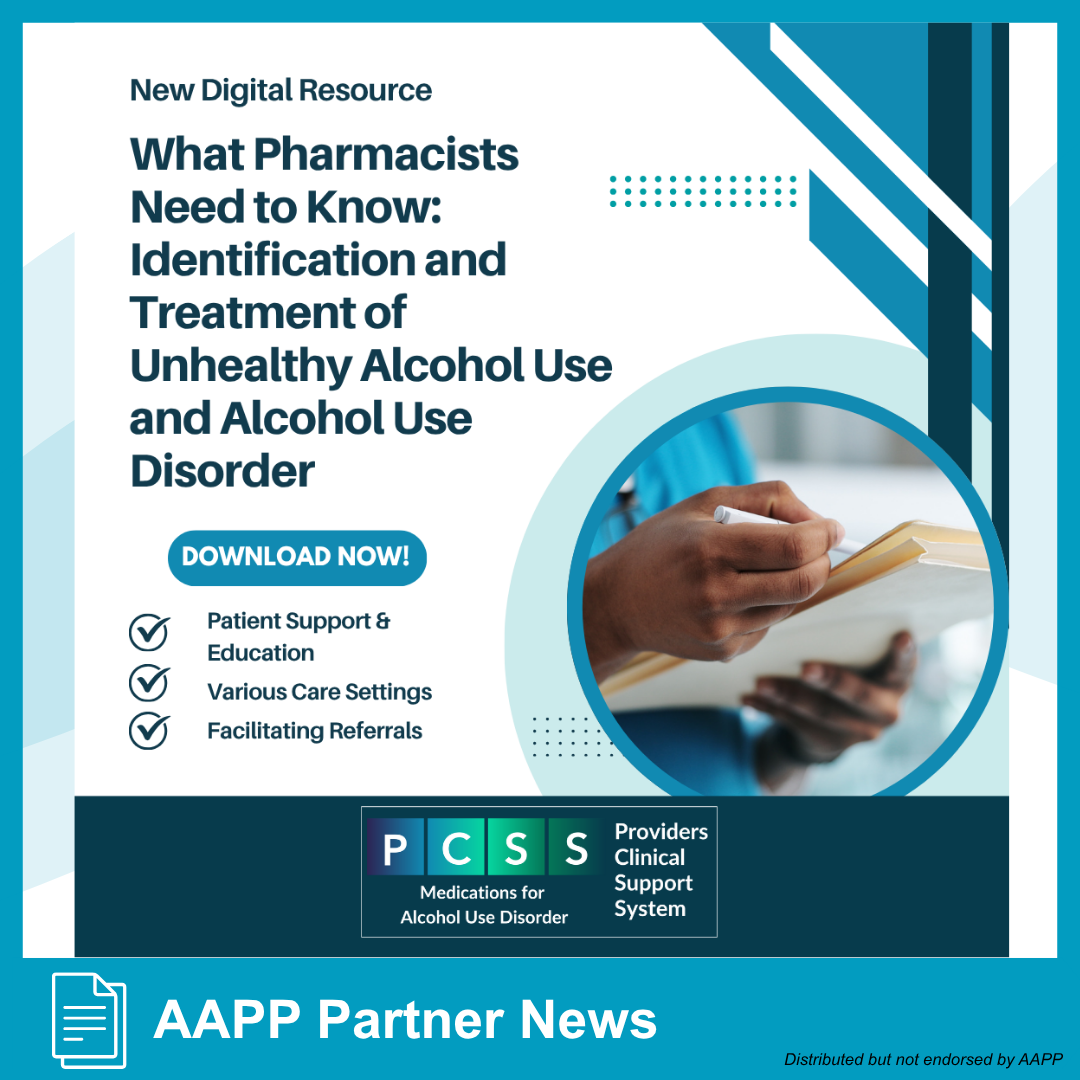
Alcohol and Depression, Anxiety, Bipolar and PTSD

Alcohol and Depression, Anxiety, Bipolar and PTSD
AAPP is pleased to announce two additional AAPP Student Chapters bringing the total number of student chapters to 49! Western University, advised by AAPP member Andrew Hean, PharmD, BCPP, and Campbell University, advised by AAPP member Andrew Muzyk, PharmD, are the newest student chapters. Congratulations and welcome to AAPP, Collegiate Chapters at Western University and Campbell University!

This review is the clinical component of a three-part series to delineate how developmental translational neuroscience can inform and guide the development and implementation of treatments for adolescent substance use.
In decision analytical model expanding ASBI delivery in primary care was projected to reduce premature mortality and may represent an important strategy for improving population health.
A summary of a recent Summit in Philadelphia of outpatient and inpatient service providers who specialize in the care of persons who use drugs to discuss medetomidine response readiness and building ongoing community readiness for potential destabilizing drug supply changes.
No summary available
In TRBD, adjunctive IV ketamine was well tolerated and associated with significant antidepressant effects.
Lower plasma iron and higher plasma selenium were each associated with greater dementia risk, identifying iron and selenium as potentially modifiable factors for dementia prevention, especially in selenium-replete populations.
Pharmacist-led CMM visits, traditionally rooted in primary care, can be successfully integrated into specialty clinics to bolster health maintenance needs and resolve MTPs to help optimize therapies, while maintaining patient satisfaction rates. This model of pharmacy supports broader adoption of CMM within specialty care, offering potential benefits to patients, providers, and payers such as reduced health care costs, decreased provider administrative burden, and improved patient outcomes.
A 10-year review found that the VA's VIONE program resulted in more than 4.3 million potentially inappropriate medications being deprescribed among more than 1.5 million veterans. The VIONE program addresses polypharmacy by prompting clinicians to classify medications as vital, important, optional or not indicated and ensure every medication has an indication. The program has an estimated annualized cost avoidance of $479 million, and more than 29,000 clinicians have used it.

The guidelines recommend offering preventive therapy to adults who experience 4 or more migraine days per month or significant migraine-related disability, emphasizing shared decision-making based on patient preferences, comorbidities, and treatment goals. Newer CGRP-targeted therapies are now incorporated alongside established options, with treatment selection guided by the strength of evidence, safety profile, and route of administration.
In TRBD, adjunctive IV ketamine was well tolerated and associated with significant antidepressant effects compared to midazolam.
This crossover pilot study assessed the feasibility and acceptability of removing UPF from the diets of patients with MDD who eat a large percentage of UPF in their diets to establish the viability of pursuing this line of inquiry by carrying out clinical trials of the impact of manipulating UPF on MDD.
The observed associations between prenatal paracetamol exposure and neurodevelopmental disorders are probably influenced by methodological limitations, including residual confounding and exposure misclassification.
Addiction clinics around the country are seeing a growing number of cases related to gas station products made from the kratom leaf and its derivatives.
For the past year, a mobile medical unit has been delivering healthcare and substance use treatment directly to Minneapolis residents in underserved communities, reaching people who often face some of the greatest barriers to care.

AAPP urges FDA to limit access to unregulated “wellness products” such as Kratom/7-OH, Tianeptine, Sildenafil, and Phenibut that are sold at gas stations, convenience stores, and online markets.
No summary available
The Lindsay Clancy trial showed reproductive psychiatry’s limitations.

No summary available
Family physicians can safely initiate and optimize buprenorphine treatment in community practice using structured but flexible approaches tailored to fentanyl exposure and patient goals.
Findings provide new insights into co-use of opioids and sedatives and help inform prevention strategies.
The higher prevalence of non-fatal overdose with opioids and stimulants compared to opioids alone across four diverse cohorts has implications for overdose prevention efforts.
In this sample of US pediatric prescribers, buprenorphine prescribing history was more strongly associated with legal clarity, and practice characteristics, and beliefs about MOUD than with clinician type.
After long-term BUP-XR treatment, discontinuation was effective and well tolerated over 6 months.