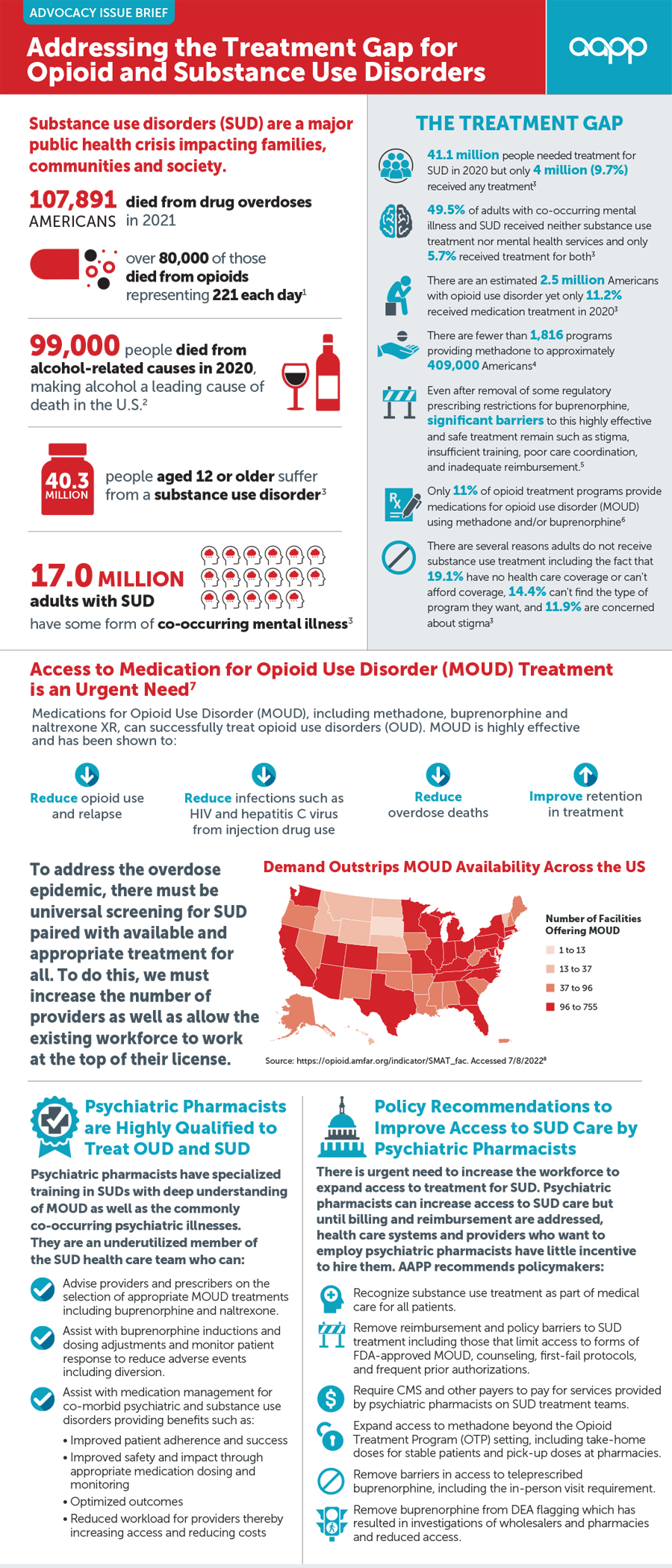
Substance use disorders (SUD) are a major public health crisis impacting families, communities and society.

Substance use disorders (SUD) are a major public health crisis impacting families, communities and society.
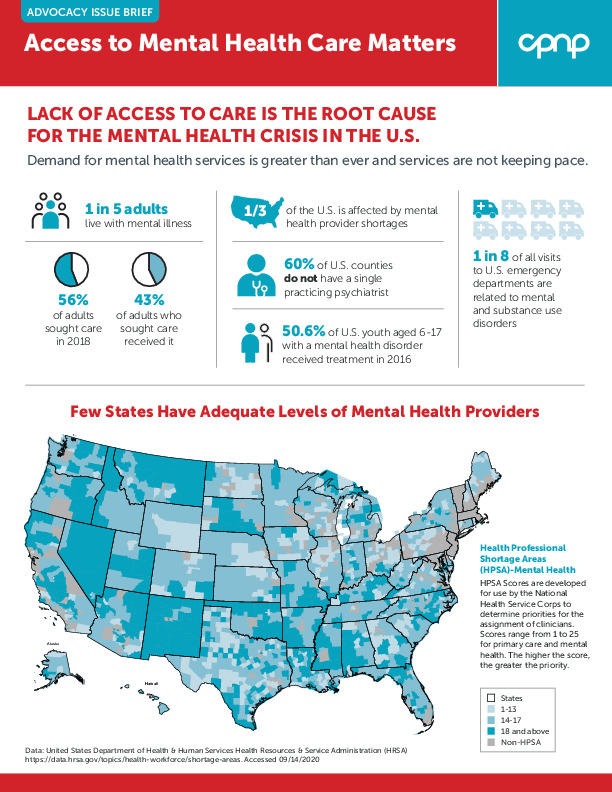
Lack of access to care is the root cause for the mental health crisis in the U.S. Demand for mental health services is greater than ever and services are not keeping pace.

Patients living with serious mental illness have complex and growing needs and the behavioral health workforce can't keep pace with the ratcheting demand for services. This fact sheet outlines this growing crisis and describes how, similar to the VA model, psychiatric pharmacists can serve as a leading option to expand access to care and assist in filling gaps. Congress must take action to remove barriers to the inclusion of psychiatric pharmacists as outlined in this fact sheet.

These results may suggest near therapeutic equivalence between phenobarbital and long-acting benzodiazepines.
This study included patients who met ICD-10 criteria for alcohol dependence or harmful use and who completed a 7-week inpatient treatment program in the Czech Republic.
ORT-exposed infants may be at risk for neurodevelopmental impairment.
Findings highlight pregnancy-related differences and racial inequities in addiction consult service and MOUD utilization during hospitalization, underscoring a potential need for stronger obstetrics-addiction collaboration and equity-focused care.
These findings highlight the utility of UDTs linked with medical and pharmacy claims data as a public health surveillance tool.
Residential treatment programs for opioid use disorder appear to be an effective and cost-effective venue for expanding the use of medications for opioid use disorder, with the greatest value achieved when care navigation links patients to community-based treatment upon discharge.
PWUOs expressed willingness to use anti-opioid vaccines, but with strong preferences for limits on duration of action and breadth of blockade. Uptake may increase if opioid vaccines offer a range of breadths and durations of action.
Results suggest that state legalization of online sports betting was associated with measurable increases in mental health care use and may increase strain on the behavioral health system.
This Clinical Considerations document addresses two urgent questions facing care teams: How do we recognize and treat medetomidine intoxication, and how do we manage moderate-to-severe withdrawal?

Compass Pathways has submitted an FDA application for its synthetic psilocybin treatment for treatment-resistant depression, with a potential market launch in the first half of 2027 if approved. The submission comes two years after the FDA rejected an MDMA-assisted therapy for PTSD, a major setback for psychedelic treatments.

The Centers for Medicare & Medicaid Services (CMS) released the 2027 Hospital Outpatient Prospective Payment System (OPPS) final rule, which maintains the existing payment structure for Intensive Outpatient Program (IOP) and Partial Hospitalization Program (PHP) services while updating payment rates using more recent claims and cost data. AAPP supported this approach in its comments, emphasizing the importance of stable payment for intensive behavioral health services.
The Centers for Medicare & Medicaid Services (CMS) released the 2027 Physician Fee Schedule (PFS) final rule, which includes several policies supported by AAPP in its comments on the proposed rule. Most notably, CMS finalized increased payment for Psychiatric Collaborative Care Model (CoCM) services, recognizing that these team-based behavioral health services have been undervalued.
These resources deepen healthcare practitioners’ understanding of SUD and highlight free SAMHSA-funded training and mentoring opportunities. The materials also provide information to integrate treatment for opioid use disorder (OUD) into their practices and expand patients’ access to lifesaving MOUD, such as buprenorphine.
The National Council for Mental Wellbeing developed this resource to center youth voices and equip caregivers, educators, health care providers, advocates and other trusted adults with evidence-based and youth-informed tools to address one of the past decade’s most pressing public health challenges: youth nicotine addiction from vaping.
This MRI study compared white-matter microstructure in 87 individuals with cannabis, opioid, or nicotine dependence and 53 nonsmoking healthy controls, examining associations with impulsive decision-making and substance use severity.
Perceived sleep disruption was associated with opioid craving and opioid consumption among individuals with CLBP receiving LTOT.
Massachusetts mandated certain jails offer all medications for opioid use disorder (MOUD) as part of a pilot test, and in this article researchers present some of the lessons learned.
Social media use and risk perception are key, modifiable factors of adolescent cannabis use. These findings may inform future prevention research focusing on credible risk communication and digital-platform contexts.
Analysis of 2016–2025 hospital discharge data found that AKI occurred in approximately one third of drug overdose–involved hospitalizations; of those, approximately two thirds involved a severe inpatient course.
This survey aimed to understand MAUD awareness and attitudes among the general public.
This study sought to examine temporal changes in nonfatal overdoses and naloxone administrations by EMS clinicians and laypersons relative to the national peak in overdose deaths.